Interview with Amanda Forbis Part 2
Click here for Part 1
By Seana Sperling
The following is an interview with Amanda Forbis, formerly on Canada's National Film Board, and part of the very talented Film making team of Amanda Forbis and Wendy Tilby. Their animated short, "When the Day Breaks," was nominated for an Academy Award last winter. Fim maker/Animator, Amanda Forbis gives insight into how this innovative film incorporates live action film with painted images, giving it a fine art look.
Q: When you and Wendy work together, do you divide up the areas: concept and script, drawings, coloring, etc.
AMANDA: When we started work together we had a one page outline of the idea of, "When the Day Breaks." From that point, we both hashed over each storyboard frame, each concept change and practically every frame of finished film. We both created the artwork (after many months of amalgamating our styles) and we went through the post-production process as a team. We had our disagreements, but the partnership was incredibly fruitful.
Q: Each frame is delicately painted and the blurred edges give it a kinetic sense. Can you describe the technique you use to get this effect?
AMANDA: First we shot live action on a High 8 video camera (nothing fancy). We used our friends or ourselves as actors to get the basic movement without worrying too much about the aesthetics of the video. Then we went back to the studio and selectively printed out frames of the action using a video printer, which creates small 4x3 thermal black and white prints. We usually manipulated the action, speeding it up, slowing it down or sometimes reversing the order. After that we photocopied the whole shot and painted over the action using oil sticks and pencil, turning humans into animals. It sounds complex, but basically you end up doing a lot of painting, which suited us both just fine, though it was very time consuming. The section of the film that features the physical connections of a city--the pipes and wires, etc. was drawn on paper by our friend Martin Rose in Vancouver. That was flipped into a negative image on the Cineon computer at the National Film Board.
Q: How long did it take to make this film?
AMANDA: Four years. We had some interruptions and the Board had some financial trouble.
Q: The movement of some of the characters is very natural looking. For instance, the shot of the man’s retreating back as he crosses the street. Do you have a technique for this?
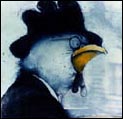
AMANDA: Sometimes, if the original video shoot was really successful, we would keep elements of the background, as in the shot of the chicken crossing the road. There you can see some of the apartment buildings behind him, rendered in a soft gray. You get a ghost of the real background through. We were attracted to the spooky combination of an animal/cartoony-type character and a recognizable, naturally moving, human character. We had to work hard to get the correct balance.
Q: Judith Gruber Stitzen and David Gossage wrote the score for, “When the Day Breaks,” Did you and Wendy have a set idea for the music or did you leave that to the composers? We had a lot of pre-set ideas and we worked really closely with Judith on the song composition. As a matter of fact we wrote the lyrics to it. Judith wrote the score and David helped her arrange it. We were very clear that we wanted something from the 30’or 40’s--swing/big band style. Each of the pieces needed to have a particular mood, so the first song is blatantly happy and the last, wistful. That was the hardest to get the right tone for. The middle song, is just sad and discombobulated and that one Judith just took and ran with. She did a marvelous job.
Q: In another area, there is a horse running in a yellow wheat field. The style is very different here and has the look of landscape painting. When I was watching this I thought, I’ll bet these were shots/paintings they really liked and just decided to use them somewhere. Why the shift in style?
AMANDA: Well, it’s colorful for one thing and that was deliberate. It took us awhile to place that shot, but it comes before you see the ambulance drive away. To us it was a transcendent moment in the life of the chicken. Either it was his favorite place or his happy hunting grounds or the place where he was born. Many of us have some sort of pastoral or perfect memory in our lives that we remember as golden and beautiful and we hoped that’s what that would convey. Something special. Also, we really did like the shot and it’s linked with the third song, “Prarie Blue,” which directly relates to those images as well. It was a repetition of those pastoral themes, city vs. country. The city in this film, is a character, and at one point it’s a threatening and horrifying place for Ruby the pig to be. She comes to terms with it in the end, but she has what we all have, a notion of a simpler life that is usually aligned with country living. A sense of human community still exists in the city, but it’s just different.
Q: “When the Day Breaks,” is the story of a pig named Ruby whose routine life is disrupted after witnessing a fatal traffic accident. What inspired the story?
AMANDA: Wendy actually wrote the story and it came out of a number of things for her. Originally there were no animal characters other than the dogs chasing the ambulance and it wasn’t a musical. She’d gone through a couple of ideas that didn’t gel too quickly. One idea was to show the sum of the parts of a human being--bones, blood cells, memories, thoughts. This was to demonstrate that a human being is as much made up of ideas as they are of flesh and blood. That translated into the scene where we see Mr. Chicken's life, strewn out on the road and we get some sense of who he was and what he was made of. Another concern that fed into "When the Day Breaks" was a dangerous street corner near to where Wendy lived in Montreal. There were near misses almost every day and several times pedestrians had been knocked down. One elderly woman was killed. Every time Wendy heard screeching tires she wondered if someone's life had been radically changed or had even ended in that moment, and who else would feel the reverberations of that event? Much of, "When the Day Breaks," is about how we are affected by the life of our community; that we are all connected even though we remain strangers.
Q: You avoid primary colors and everything is hybrid, from the sparsely used magenta to a pale apricot. This gives it a fine art sense and makes me wonder if you studied painting.
AMANDA: I did go to art school, in fact Wendy and I both went to the Emily Carr College of Art which is now called the Emily Carr Institute of Art and Design in Vancouver. For the colors, we worked really hard for a limited palette. We were really attracted to rich deep blacks and strong whites with a kind of patinated quality about them.
Q: Do you consider yourself a painter?
AMANDA: No, but more so than I did before. Four years of painting will help. I’m more interested in sequential movement and story--the kind of ideas that go with film making than I am in creating single images.
Q: Are you more interested in being a film maker or an animator? Or both?
AMANDA: I think I'd say I am more interested in being a film maker. I do find animation very interesting and challenging though.
Q: Do other styles of animation interest you such as, Stop Action?
AMANDA: Definitely not Stop Action. We might experiment with different techniques in the future but they will be 2-D techniques I’m sure. I did a film in Vancouver using Cut-Out Animation and I really like that. That’s an area where I enjoyed the animating because you do it under the camera so you’re committed to the move you just made each time you take a frame. It’s like a type of performance because you have a certain amount of time and you create something and then it’s over. I miss it.
Q: What about Computer Animation?
AMANDA: No. I’m definitely interested in what the computer can do to augment the creation of art, but the computer as an end product for a visual look, I don’t like at all. I was just at the Ottawa International Festival of Animation in September, and noticed computer films are getting better. People are using them in more aesthetically pleasing ways, but I tend to find them kind of revolting.
Q: So many talented people are working in paint stores, waiting tables, driving cabs, etc. There’s this image of the starving artist that has its basis in reality. How do you usually pay the rent? Are you able to support yourself through creative efforts or are you teaching art or something else?
AMANDA: This is where Canadians have it good compared to Americans, in the sense that I worked at the National Film Board and they paid me to make that film. Not that all or even many Candians have had the same opportunity as I have, but at least there are possibilities open. This is something that’s much harder to find down here in the States. It makes me appreciate how lucky I am.
Q: Have you ever taught?
AMANDA: I’ve taught a lot of kid’s classes. Kids from about 12- 17. I just did a couple workshops in Saskatchewan. I enjoyed that and I enjoy it more now than I used to. I feel like I’m getting more of a grip on teaching techniques, how to teach and how to be with students in a classroom. As a result, I’ve really enjoyed my latest forays into teaching.
Q: What is the most bizarre/non art-related job you’ve ever had?
AMANDA: That’s a cruel question. I don’t even know if I should admit to this. The worst job I ever had was my three days as a Dickie Dee ice cream vendor. It was a terrible job because they robbed us blind and you went out on those little bicycles with the bells. You have to have huge thighs just to peddle those things around. It was a brutal job and I managed to crack my tailbone too. I was using one of those three wheeled automobiles and when I ran back to the truck to get some change for a customer. I threw myself into the truck and hit the ledge square on. It was months before I could sit down without wincing. That was sort of a low point for me.
Q: What are you doing in Boston?
AMANDA: I’m supposed to have been helping Wendy do a trailer for the Harvard archives. She's teaching Animation there. It is a non- paying job, but we thought it might be the means of getting up to speed on some computer programs. We are way behind and we’re interested in using programs like Photoshop and After Effect to help us in our work . There’s no denying that the computer is just a fantastic tool. I don’t know if it could do what we did for, “When the Day Breaks,” but it can do other things that are great. So, I’ve been learning programs.
Seana Sperling is a freelance waiter, uh, writer, in Seattle.
What do you think? Leave your comments on the Guestbook!