Interview with Amanda Forbis Part 1
By Seana Sperling
Editor's Notes Keen eyed readers may notice that our current interviewee, Amanda Forbis, has the same last name as I, your faithful Acid Logic editor. This is because we are indeed related, Amanda is my cousin, and I hers. Of course I've known about her burgeoning animation career for some time now, but when I heard that she had narrowly missed receiving an Academy Award for her work, (after receiving a nomination for the "Best Animated Short Category") only one thought went through my head: "What a loser! She can't even win an Academy Award? How hard can that be?"
As such, it seemed best to let Amanda be interviewed by A.L. contributor Seana Sperling, someone with a bit more tact and an actual knowledge of animation.
Wil Forbis
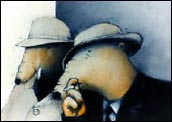
Two characters from "When The Day Breaks."Click here for more info and streaming video from the film.
In 1999, the National Film Board of Canada released, "When The Day Breaks," an animated short, created and directed by the talented filmmaking team of Amanda Forbis and Wendy Tilby. The film went on to win several awards including the Short Film category at Cannes and more recently, a Y2K Oscar nomination. As an avid animation fan, it was a great pleasure for me to get an opportunity to interview Amanda Forbis about her filmmaking techniques and Oscar night experience.
Q: When you heard about the nomination, what went through your mind? Capitalists/ Superficial Hollywood Geezers/Damn--I suppose I'll have to dress up.
AMANDA: I was thrilled. It is a big fish. It almost doesn't matter what you think of the Oscars in a way. It's a great honor and it's very good for the film. It's a lot of work in the sense that you have to do a lot of interviews and people just expect things from you and you can't fade into the background. I noticed this with a friend Torill Kove, who was nominated for "My Grandmother Ironed the King's Shirts." We all went to a party at the Norwegian Consulate and suddenly we noticed that all the attention was shifted to Torill, so we just sat down at a table and ate and it was so wonderful. Afterwards, Torill said she kept trying to put some food in her mouth and every time, someone would ask her something.
Q: Can you tell me a little about your Oscar night experience?
AMANDA: In retrospect, it was lot of noise and very little content. It was fun, but it was also extremely exhausting. I got some small insight into what it would be like to be really famous and I think it would be really hard. You would have to adore being in the spotlight and pestered all the time. We discovered it just wasn't for us, but the actual night was quite a bit of fun and there were some great events surrounding it. We had a nice lunch at the Canadian Consulate.
Q: Any encounters with the Hollywood Aristocracy?
AMANDA: We ran into Robin Williams in Roots Shoe Store. He's a long way from being that type of, "Don't look at me." celebrity. He's very chatty and friendly and very likeable. It's just surprising to come face to face with someone who is so recognisable and talk with them about shoes. After he found out we were going to the awards, he told us he was going to be backstage because it got a little bit boring and the way to have fun was to be in the back. At that moment, a young woman, about 20-something, was passing by and she saw him and did a double take. She was so excited. Then she ran in and grasped his hand and, gushed, "Oh, ohh, I want to be you. Oh, I'm gonna cry." And he said, "Don't do that. Save your moisture."
Q: And at the Awards?
AMANDA: We saw a lot of people in the auditorium of course, but the way it worked was, the nobodys like us arrived an hour in advance and they have people that herd you into the building so you don't loiter on the red carpet and ogle stars. Here you have a situation where you're some kind of a star in your field and you're ogling the real stars and they don't want you to do that. They really want you inside the building and then they make all sorts of announcements that you must take your seat. You have to ignore all of them so you can see the movie stars, because that's what you're there to do. The movie stars all arrive in the five minutes prior to the show and in those five minutes they're warning everyone else to get to their seats or they'll close the doors on you. And you're thinking, "You're not gonna shut Tom Cruise out." The highlight of the evening was when Robin Williams did the, "Blame Canada." song from the South Park movie. It was the high energy moment of the whole evening and he was wonderful. It was fun and as a Canadian it was an unparalleled thrill.
Q: What are you doing in Boston?
AMANDA: I'm supposed to have been helping Wendy do a trailer for the Harvard archives. She's working teaching Animation there. It is a non- paying job, but we thought it might be the means of getting up to speed on some computer programs. We are way behind technologically and we're interested in using programs like Photoshop and After Effect to help us in our work . There's no denying that the computer is just a fantastic tool. I don't know if it could do what we did for, "When the Day Breaks," but it can do other things that are great. So, I've been learning programs.
Q: So, how has the Oscar nomination changed your life and what's the next step? Any calls from Hollywood?
AMANDA: Had a couple of phone calls, nothing ever came of them. One of them was kind of open-ended. Hollywood actually called before the Oscars. They called after Cannes. I dont know if I should say who, but a big Hollywood production company told us if we ever wrote a script they would like to look at it. Which was nice, but other than that, not really. We have gone to a lot of festivals which has been great. Also we've done a lot of travelling with the film, so in that way, life changed a lot.
THE NEA vs. NFB
Q: You worked for The National Film Board for a number of years and are aware of the political climate surrounding the Arts. In the U. S. there has been a conservative trend since the 1980's that has effected funding for the NEA (National Endowment of the Arts) and other sponsors. In some cases there was an outcry to cut funding for certain controversial projects or to even prohibit the exhibition. Has this become a trend in Canada as well?
AMANDA: I'm very saddened by what's happened to the NEA. What people don't seem to realise is, sure, the NEA is going to fund some crap just like the film board will fund some crap, but with the chaff you get wheat and public funding gives talented, non-commercially-motivated people the opportunity to create adventurous and risky work. You get work that you would not get if it were all dictated by commerce and private money agendas.
Q: How much support does Canada give Public film and has the support decreased over the last 20 years?
AMANDA: In 1995, the board which had a budget of, I'm guessing, 80 million, and it was reduced by 30 million, during those four years we worked on the film. We saw drastic changes. The NFB in Montreal had been a full production facility. They could process film, run sound mixes, do visual effects, they could do everything in one big building and it just isn't that way any more. The film lab has been shut down and the shooting stage was sold. We saw some harsh changes in the board while we were there. I always feel that the board needs defending. It's not particularly well thought of in Canada. It's not poorly thought of, but it's not well thought of. The thing that frustrates me is that if I go to a festival in another part of the world, and they hear that I work at the Film Board they all practically collapse in envy, saying, "Oh my god. You are so lucky."
Q: When you receive funding, do you have autonomy or are you monitored/censored?
AMANDA: It depends on the mandate of the project at the film board. If it's an educational film or another type of film with an imposed structure, they will watch that in a different way than a film they expect to wind up at festivals. I guess an auteur film will be watched in different way. It's very delicate and difficult for a producer to know when to stick their nose in and when to pull back. Our producer David Verrall was really great in that he discussed a lot of important issues and gave us a lot of room to do what we wanted to do. We were really grateful for that.
FAMILY SECRETS
Q: I heard that your aunt invented Q-Tips.
AMANDA: Yep, my Aunt Hazel invented Q-tips and as you can imagine it is an immeasurable source of pride for our family. Actually, I love to bring it up at parties, but for some reason no one ever believes me. I mean someone's aunt had to to invent them. Too bad we're not all rich from it, but there you go. She sold the patent way back, but she made pretty good money at the time.
Seana Sperling is a freelance waiter, uh, writer, in Seattle.
What do you think? Leave your comments on the Guestbook!